


If you're thinking about getting one, or you already own one and want to understand what you've got, this is the actual story of how the 330 works and what to expect.
What you're actually buying when you get a 330
The 330 is a semi-hollow guitar. That means it has a body with some air inside—it's not solid like a Telecaster, and it's not a big resonant box like a jazz guitar either. It's somewhere in the middle, and that in-between quality is most of what makes it special.
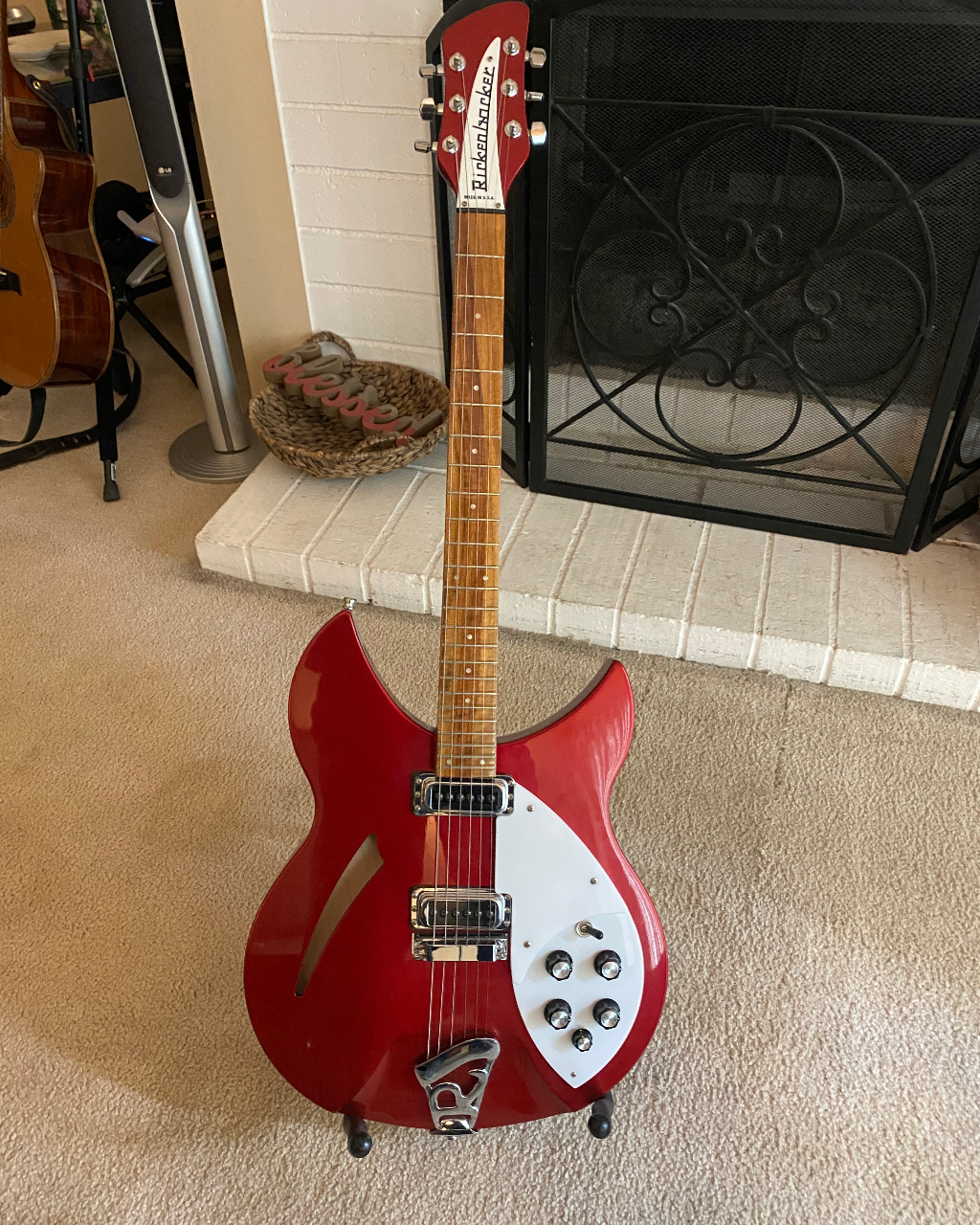
The body is maple. The pickups are single-coil Rickenbacker Hi-gain units, which is a specific thing. They're not hot by modern standards. They're not trying to sound like a Les Paul or a Strat. They sound like themselves, and if you're buying a 330, you're buying because you want that particular voice.
The neck is 24.75 inches long with 24 frets. The nut is about 1.63 inches wide—slightly narrower than some guitars, which matters if you have larger hands. The whole thing usually weighs between 7 and 8 pounds. It won't kill your shoulder after four hours of playing, which isn't nothing.
You'll get a bunch of controls: two volume knobs, two tone knobs, and a blend knob that lets you balance the pickups. There's a three-way toggle for pickup selection and that distinctive R-shaped tailpiece that looks like it came from 1958 because, well, it basically did.
Most 330s come in Fireglo, Jetglo, or Mapleglo finishes. There are limited colors too, but good luck finding them. The current backorder situation means if you order one today, you might be waiting 12 to 24 months. That's not an exaggeration. People want these guitars.
The sound is the point
Here's what you need to know: the 330 is bright. Not bright in a harsh way, necessarily. Bright in a clear way. It cuts through. When you play an open G chord on a 330, you hear all the notes—each string is defined. You're not getting a fuzzy, blended wash of sound. You're getting information.
That brightness comes from several places at once. The semi-hollow construction resonates in a way that emphasizes the upper midrange. The Hi-gain single-coil pickups are naturally detailed and present. The body shape—that crescent moon double-cutaway—contributes to how sound projects outward.
In a mix, assuming you're recording or playing with other instruments, the 330 occupies a specific frequency space. It doesn't fight with the bass. It doesn't compete for the same airspace as a vocal. It sits there, and if you've arranged things right, it adds sparkle and definition without being obnoxious.
Play the same chord on a Gibson ES-335—the most obvious comparison—and you'll hear the difference immediately. The ES-335 is warmer. It has more low-end presence. The 330 is leaner. More focused. Some people call it jangling. That's not wrong, but it's not the whole thing either.
The 330 responds to what you do. If you play lightly with fingernails or a soft pick, it sounds delicate. If you dig in, it gets more aggressive. That responsiveness can be a feature or a frustration, depending on what you're after.
Where this guitar actually works
The 330 thrives in specific musical contexts. It's the guitar for jangle pop. It's what you reach for when you want clean, articulate rhythm work. It's ideal for indie rock, alternative music, worship settings, and anything where clarity matters more than thick sustain or overwhelming presence.
You'll hear it on records where the rhythm guitar is a melodic instrument in its own right. Not something supporting the band, but something carrying part of the song's identity. It's perfect for that role.
Where it struggles: heavy rock, blues lead work, anything that needs a lot of sustain and thickness. You can make it work in those contexts if you're determined, but you'd be fighting the guitar's natural tendencies. That seems pointless when there are better options.
If you own multiple guitars—and if you're thinking about a 330, you probably do—it's the instrument you pull out when you need something specific. It's not a workhorse. It's a specialist.
Setting one up so it doesn't drive you crazy
Out of the box, a new 330 probably won't feel perfect. They ship with whatever setup Rickenbacker decided was reasonable, and that's often not the same as what works for your hands or your playing style.
You need to address a few things. First, the neck relief. Sight down the neck and see if there's a slight forward bow. There should be, but not too much. You're looking for something around the thickness of a business card at the seventh or eighth fret. Get that wrong and everything else is uphill.
If the relief is off, adjust the truss rod. Make small quarter-turn changes, then wait a few minutes. The neck needs time to settle. Don't keep turning and checking constantly. It's annoying, but it works.
Next, the action at the bridge. How high are the strings? Play some chords and see if there's fret buzz. Lower the bridge posts until you find the sweet spot where things are playable without rattling. This is feel-dependent. What works for me won't necessarily work for you.
The nut slots matter too. If they're too high, the guitar feels uncomfortable in the first position. If they're too low, you get open-string buzz. You might need a professional to fix these. It's usually not expensive, and it's worth doing right.
Finally, intonate the guitar. Compare the 12th-fret fretted note with the 12th-fret harmonic on each string. They should match. Move the bridge saddles if they don't.
Spend a few hours on setup and you'll transform how the guitar feels. Skip it and you'll be frustrated.
Strings, pickups, and small choices
Most people use 10-46 or 11-49 gauge strings on a 330. The lighter set is easier on your fingers. The heavier set gives you a bit more tone. Neither choice is wrong. Try both if you can and pick based on feel and sound.
The stock pickups are fine. They're actually quite good. Some people eventually swap them for something hotter or something vintage-sounding, but you don't need to do that to get the 330 to sound like itself. It already does.
The tone knobs actually work on this guitar, which is nice. Roll them off and you get a warmer sound. Max them out and you get the full brightness. The blend knob lets you split the difference between neck and bridge pickups. Learn how to use these three controls and you've got more tonal range than the stock settings suggest.
How to record with it without overthinking
Plug the 330 into a clean amp. Add some light compression—just a few decibels of reduction when you dig in. Throw some chorus on it if that's your thing. Add reverb if the space feels dry. That's basically it.
You don't need anything fancy. A Vox-style amp or amp model, a compressor, maybe some modulation and reverb. The guitar itself handles a lot of the sonic work. Your job is just to not get in the way.
If you're layering multiple guitar parts, pan them wide. One rhythm guitar hard left, another hard right. It fattens the sound without getting muddy.
High-pass filter around 80 hertz or so to clean up any low rumble. That's a small thing that makes a big difference in how clean the overall mix feels.
Why people keep coming back to it
The 330 has been in continuous production for nearly 70 years. That's not an accident. It works. It sounds good. It feels good to play once it's set up right. And it sits in a specific tonal space that other guitars don't occupy quite the same way.
Is it perfect? No. The neck is a bit narrow if you have big hands. The brightness can be unforgiving if your technique needs work. The semi-hollow body can be prone to feedback if you're not careful with amp volume and positioning.
But these are small things compared to what you get. You get a guitar that's instantly recognizable. That sounds better in recordings than most people expect. That makes you want to play it.
If you're a collector, the 330 is investment-grade. Values have been climbing. A well-maintained example from the 1980s or earlier holds serious money. Even newer ones maintain value relatively well if you take care of them.
If you're a working musician, the 330 is a legitimate tool. It does its job without complaining. You can tour on it, record with it, play clubs and theaters and festivals with it.
If you're just curious, rent or borrow one and spend a few hours with it. See if the sound and feel resonates. That's really the test. Either it clicks for you or it doesn't.
The practical stuff
The 330 is expensive. Expect to pay somewhere in the 2,000 to 2,500 dollar range for a new one. Used examples vary depending on condition and age, but they hold value. You're not going to lose half your money if you decide you don't want it in a year.
Finding one might take time. Current demand is real. If you want one, start looking now.
If you get one, protect the finish. It's beautiful when it's clean. Set up a regular maintenance routine—check the truss rod occasionally, keep the frets clean, keep the strings fresh. These guitars last decades with basic care.
Learn to set it up yourself, or find a tech you trust. It's worth it.
That's the 330. Not mysterious. Not magical. Just a very effective guitar that does what it's designed to do, and does it well. If that sounds like what you need, now you know what you're getting into.
Buy, sell, or trade your next piece of gear on Resyn instead of letting it sit on a stand. List in minutes, pay zero seller fees, and deal directly with real musicians who actually understand what you’re offering. Whether you’re flipping a vintage guitar, hunting for a rare pedal, or trading into your next main rig, Resyn gives you a clean, music-only space to do it on your terms.

